From Independence to Invasion
Ukraine’s European path did not begin in 2014. From the 1991 referendum and the Orange Revolution to Maidan, Crimea and the 2022 invasion, this explainer traces how democratic choice collided with Russian imperial power.
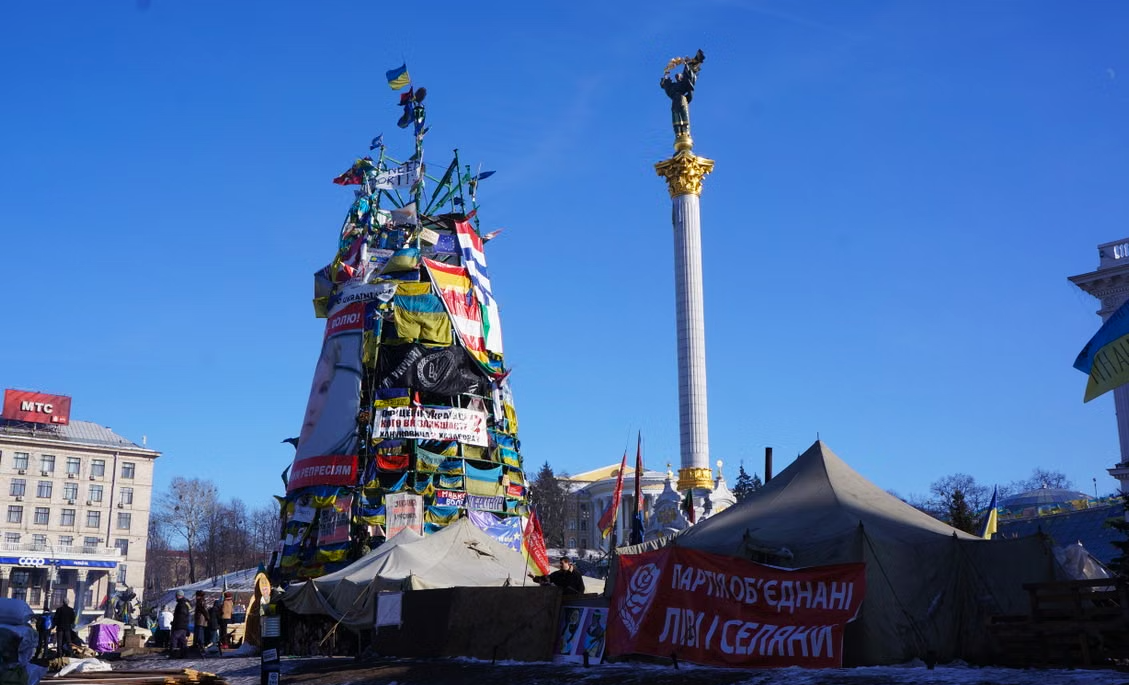
Ukraine’s path towards Europe did not begin in 2014, nor was its independence an accident of the Soviet collapse. From the 1991 referendum and the Orange Revolution to Maidan, Crimea and the full-scale invasion, this explainer traces how Ukraine’s democratic choices increasingly collided with Russia’s refusal to accept its political independence.
How Ukraine’s Democratic Choice Became a War with Russia
Russia’s full-scale invasion of Ukraine on 24 February 2022 did not emerge from nowhere. Nor did Ukraine suddenly turn towards Europe because of a Western intervention in 2014. The road to war began much earlier. It passed through the dissolution of the Soviet Union, Ukraine’s referendum on independence, the Orange Revolution, the Revolution of Dignity, the annexation of Crimea and eight years of fighting in the Donbas.
Understanding that chronology matters because many of the arguments still used to justify the invasion depend upon erasing it.
1991 was no accident
Some years carry the weight of an entire decade. For long periods, history appears to move slowly, until events suddenly accelerate and political structures that once seemed permanent collapse within months. The years between 1989 and 1991 formed such a historical acceleration.
In November 1989, the Berlin Wall fell. Less than a year later, East and West Germany were reunited. Across Central and Eastern Europe, communist regimes collapsed. The image of Romanian leader Nicolae Ceaușescu staring in disbelief as the crowd interrupted and jeered his final public speech became part of Europe’s collective memory.
In August 1991, hardliners attempted a coup against Soviet leader Mikhail Gorbachev. Boris Yeltsin climbed onto a tank outside the Russian parliament, the authority of the Communist Party disintegrated further, and by the end of that year the Soviet Union had ceased to exist.
This was not only the end of a communist political system. It was also the collapse of an imperial political space that Moscow had inherited from the tsars and extended through the Soviet Union and its satellite states.
Tsarist and Soviet Russia were ideologically very different. Yet both were organised around a powerful centre in Moscow and controlled an enormous territory containing many different nations. The Soviet system added another layer of influence through the Warsaw Pact and the communist governments of Central and Eastern Europe. In that sense, 1991 marked not only the end of the Soviet Union, but also the disintegration of a centuries-old political order in which Moscow considered itself the natural centre of a much larger geographical space.
Ukraine was part of that transformation.
On 24 August 1991, the Ukrainian parliament declared the country an independent democratic state. On 1 December, that decision was submitted to the population in a nationwide referendum. The result was overwhelming: 90.32 per cent of those who participated voted for independence. A majority voted in favour in every part of the country. In Crimea, 54.19 per cent supported independence; in Sevastopol, the figure was 57.07 per cent. In Donetsk and Luhansk, support exceeded 83 per cent. Independence was therefore not imposed upon predominantly Russian-speaking regions against their will. It was supported throughout the country.
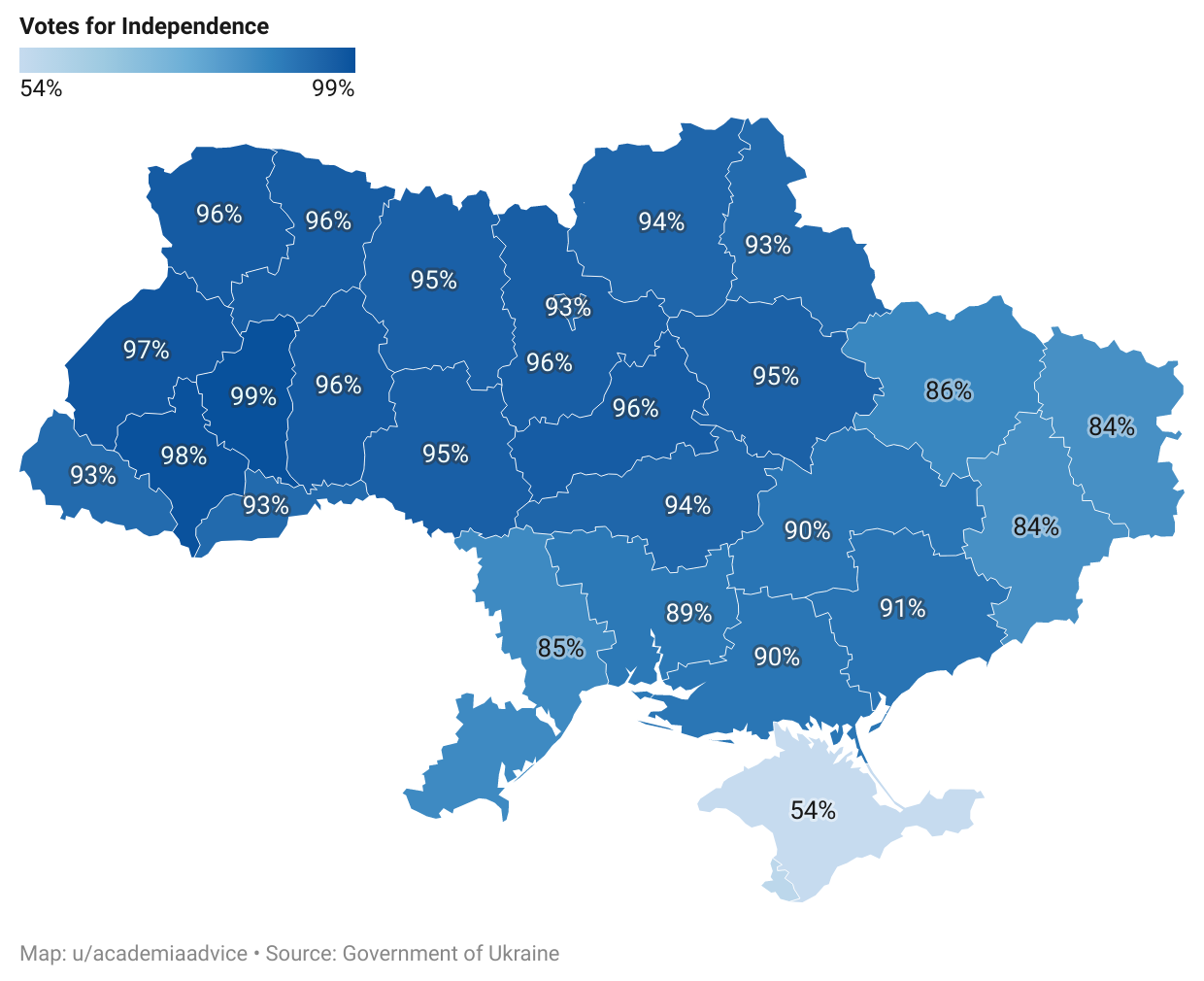
That referendum is one of the clearest answers to Vladimir Putin’s later claim that independent Ukraine was an artificial construction imposed upon an unwilling population. Ukraine was not torn away from Russia by the West in 2014. Its people chose a separate state in 1991 - including in Crimea and the Donbas.
Russia formally recognised Ukrainian independence. Nevertheless, an important part of the Russian political and intellectual elite continued to regard Ukraine as something less than a fully separate nation: a lost province, a historical mistake or an integral component of a wider Russian world. The Ukrainian state was recognised legally, but it was never completely accepted emotionally or imperially.
The 1990s were extremely difficult. Like several other former Soviet republics, Ukraine suffered economic collapse, institutional instability and the rapid growth of oligarchic power. Former communist officials, regional political networks and newly wealthy business figures acquired enormous influence over government, industry and the media.
At the same time, Ukraine gradually began to reconstruct its own institutions and identity. Ukrainian was strengthened as the official language of the state. Ukrainian versions of names and concepts returned to government, education and public life. The process was slow, regionally uneven and sometimes contentious. Ukraine did not break completely with its Soviet inheritance or its close cultural and economic relationships with Russia. It was searching - often uncertainly - for its own political, economic and national form.
One crucial decision came in 1994. Following the dissolution of the Soviet Union, a vast nuclear arsenal remained on Ukrainian territory. Through the Budapest Memorandum, Ukraine agreed to surrender those weapons and join the Nuclear Non-Proliferation Treaty as a non-nuclear state. In return, Russia, the United States and the United Kingdom reaffirmed commitments to respect Ukraine’s independence, sovereignty and existing borders, and to refrain from the threat or use of force against it.
These were security assurances rather than an automatic military-defence guarantee. Nevertheless, their political meaning was unmistakable. Ukraine relinquished one of the world’s largest nuclear arsenals in the expectation that its sovereignty and borders would be respected. Russia would later violate the commitments it had itself made.
2004 — Ukraine comes into motion
In 2004, it became visible that the European Union’s eastward enlargement might not end at its new borders. On 1 May, ten countries joined the EU. They included Poland, Hungary, Czechia and Slovakia, as well as Estonia, Latvia and Lithuania—three former Soviet republics. Bulgaria and Romania followed in 2007, and Croatia in 2013. Countries that had recently belonged to the Soviet Union, the Warsaw Pact or Yugoslavia were being anchored politically and institutionally in the European Union.
At the end of 2004, Ukraine also began looking more clearly towards the West. Viktor Yushchenko, a former central-bank governor and prime minister, stood for president as a reformist candidate. During his period as prime minister, he had attempted economic reforms and challenged parts of the oligarchic system, but his government was brought down in 2001 by a coalition of political and economic interests.
His principal opponent in 2004 was Viktor Yanukovych, the serving prime minister and Moscow’s preferred candidate. The election campaign was extraordinarily bitter. Yushchenko became gravely ill and was found to have been poisoned with an exceptionally high dose of dioxin. The poisoning itself was established, but the person or organisation that ordered it was never conclusively identified.
The second round of voting was marked by widespread irregularities. International observers concluded that it had failed to meet numerous democratic standards. When Yanukovych was nevertheless declared the winner, hundreds of thousands of Ukrainians took to the streets. Wearing orange scarves and carrying orange flags, they occupied Kyiv’s Independence Square and refused to accept the falsified result. The Ukrainian Supreme Court annulled the disputed second round. A repeat vote was organised, and Yushchenko won the presidency.
The Orange Revolution was not simply an anti-Russian or exclusively pro-European revolt. It was first and foremost a civic uprising against electoral fraud, corruption and the belief that political power could disregard the votes of citizens without consequences.
But it demonstrated that Ukraine was developing differently from Russia. Ukrainians were not a passive population prepared to obey decisions taken by political elites or in the Kremlin. They possessed an increasingly active civil society and the ability to organise beyond the control of the state.
What would become even clearer after 2014 and 2022 was already visible in 2004: in Russia, the Kremlin was steadily subordinating society to the state; in Ukraine, society repeatedly attempted to hold the state accountable.
2005–2013 - Promise and disappointment
Yushchenko’s election and Yulia Tymoshenko’s appointment as prime minister did not create a straight road towards Maidan and Europe. As in many former Soviet republics, political and economic transition remained difficult. Ukraine continued to be pulled between groups seeking closer integration with Europe, forces preferring close relations with Russia, and oligarchs unwilling to surrender their economic and political influence.
The coalition created by the Orange Revolution soon became divided. The relationship between Yushchenko and Tymoshenko deteriorated into personal rivalry and mutual distrust. Tymoshenko remained an opponent of Yanukovych’s political camp, but she did not always behave like the unequivocal liberal-democratic reformer that some supporters had imagined in 2004.
Ukrainian politics remained highly personalised and connected to oligarchic networks. Corruption stayed deeply embedded in the state and economy, while the living standards of many citizens improved too slowly. The expectations raised by the Orange Revolution had been enormous. Disappointment was therefore equally substantial. By the time of the 2010 presidential election, Yushchenko retained only a small fraction of his former electoral support.
The international financial crisis of 2008 compounded these problems. Ukraine’s economy contracted sharply, its currency lost value and the country became more dependent on international financial assistance. This combination of economic insecurity, political division and disappointment allowed Viktor Yanukovych to return. In 2010, he defeated Tymoshenko in a presidential election that international observers assessed as competitive and broadly compliant with democratic standards. His return was therefore not a coup or an immediate reversion to dictatorship. It was the outcome of an election.
Initially, Yanukovych appeared ready to pursue a pragmatic course. He sought better relations with Russia while continuing negotiations on an Association Agreement with the European Union. Those negotiations, which had begun in 2007, were formally concluded in December 2011. The agreement was not merely a free-trade arrangement. It would bring Ukraine closer to European rules, markets and political institutions.
At the same time, however, Yanukovych’s domestic government became increasingly authoritarian. Power was concentrated around the presidency, independent institutions came under pressure, and political opponents were prosecuted. Tymoshenko was convicted and imprisoned in proceedings widely criticised as politically motivated.
Yanukovych therefore wanted many of the economic advantages of cooperation with Europe but appeared much less willing to accept the political and Rule of Law expectations accompanying it. That contradiction would eventually become unsustainable.
2013–2014 - From Euromaidan to the Revolution of Dignity
In November 2013, Ukraine appeared ready to sign the Association Agreement at an EU summit in Vilnius. On 21 November, however, Yanukovych’s government suddenly suspended preparations. The decision was officially explained in terms of Ukraine’s economic and national interests, but it followed intense political and economic pressure from Moscow.
For many Ukrainians, the agreement represented much more than trade. It symbolised the possibility of better institutions, less corruption and a political future connected to Europe. When Yanukovych blocked that path at the final moment, students and young activists gathered on Kyiv’s Independence Square - Maidan Nezalezhnosti.
The first demonstrations were relatively small and peaceful. That changed during the night of 29–30 November, when the Berkut special police violently attempted to clear the square, beating students and other protesters.
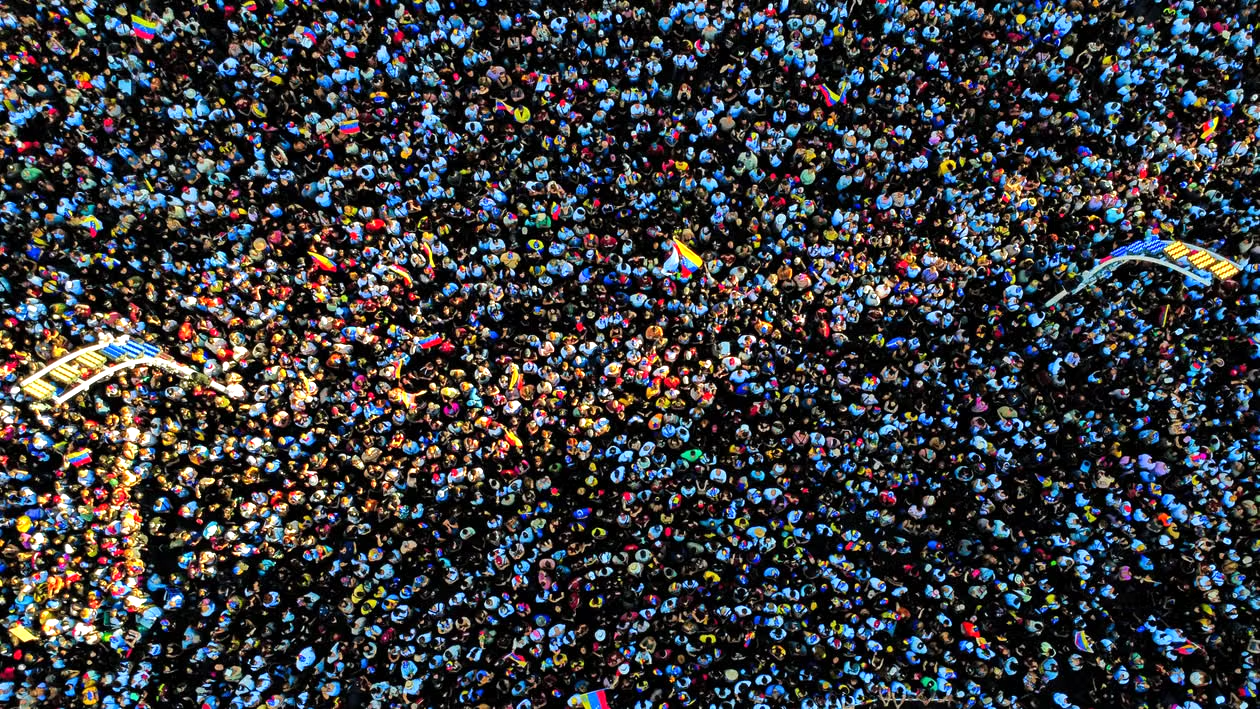
The repression was intended to end the movement. Instead, it transformed it. Images of the police violence spread rapidly, and hundreds of thousands of people subsequently joined the demonstrations. The protests no longer concerned only the Association Agreement. They became a broader rejection of corruption, police brutality, arbitrary government and Yanukovych’s increasingly authoritarian rule.
In January 2014, parliament adopted highly restrictive anti-protest laws. Confrontations escalated. Protesters built barricades and occupied public buildings. Radical nationalist groups became more visible within a much broader and diverse movement, while the authorities increased their use of force.
Between 18 and 20 February, violence reached its height. Live ammunition was used in central Kyiv. The United Nations recorded the violent deaths of 83 protesters, 13 members of the security forces, a journalist and a bystander between 21 January and 20 February. On 20 February alone, 49 protesters and four law-enforcement officers were killed.
On 21 February, after mediation by the foreign ministers of Germany, France and Poland, Yanukovych and opposition representatives signed an agreement providing for constitutional reform, a national-unity government and early elections.
It came too late. After the killings, trust had collapsed - even among many of Yanukovych’s former allies. Yanukovych left Kyiv. His security structure disintegrated, and members of parliament abandoned him. On 22 February, 328 of the Ukrainian parliament’s 447 members voted to declare that he had withdrawn from performing his constitutional duties and to organise an early presidential election.
This was not a textbook impeachment procedure. It was an improvised constitutional and political response to the flight of the president and the sudden collapse of executive power. But neither was it a secret coup organised by NATO or a small group of Western agents. It was the outcome of a mass Ukrainian protest movement, state violence, the destruction of the president’s political coalition and his departure from the capital.
Yanukovych travelled first to eastern Ukraine and Crimea and eventually reached Russia.
The domestic crisis did not end there. Within days, armed men without insignia began taking control of strategic sites on the Crimean Peninsula.
2014–2021 — The war Europe lost sight of
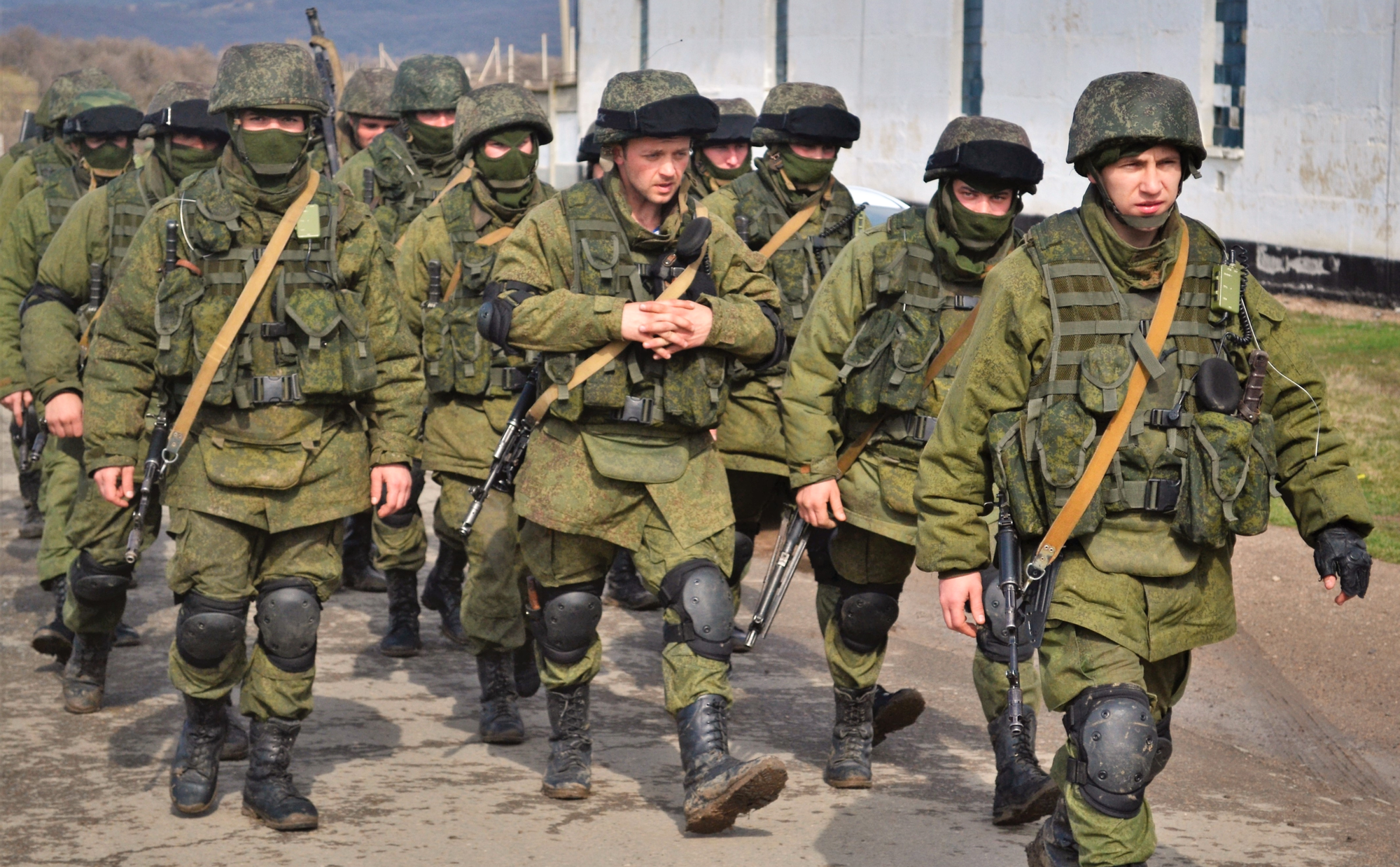
On 27 February 2014, armed men in unmarked green uniforms seized the Crimean parliament and other important buildings. They became known as the “little green men.” Moscow initially presented them as local self-defence forces, but the operation was carried out with the direct involvement of Russian military personnel. The European Court of Human Rights later found that Russia had exercised effective control over Crimea from 27 February 2014.
On 16 March, a referendum was held under military occupation. The ballot did not offer a genuine option to preserve the existing constitutional situation, credible independent international observation was absent, and the vote violated the Ukrainian Constitution. The United Nations General Assembly affirmed Ukraine’s territorial integrity and declared that the referendum had no validity. Russia nevertheless annexed Crimea.
At almost the same time, armed groups began occupying government buildings in parts of Donetsk and Luhansk. There were genuine local grievances concerning Kyiv, language policy, economic decline and the political transition after Maidan. But the conflict was not merely a spontaneous civil war between two equivalent Ukrainian camps.
Russian citizens and security-linked figures played important organising roles. Fighters, weapons, funding and later regular Russian forces crossed the border. The European Court of Human Rights eventually concluded that Russia’s military presence and decisive political, military and economic support placed separatist-held areas under Russian effective control from May 2014.
In May, the self-proclaimed “people’s republics” of Donetsk and Luhansk organised unrecognised votes on self-rule. They were held under armed authority and outside Ukraine’s constitutional framework. Unlike Crimea, these territories were not formally incorporated into Russia in 2014, although Moscow sustained and controlled the separatist structures.
On 25 May 2014, Ukrainians elected Petro Poroshenko president. The election took place while Crimea was occupied and fighting was escalating in the east. The war created a major humanitarian crisis. Hundreds of thousands of people fled their homes during its first year. By early 2015, close to one million people were registered as internally displaced, while hundreds of thousands more had sought asylum or other forms of residence in Russia and neighbouring countries.
In September 2014, Ukraine, Russia and the Organization for Security and Co-operation in Europe reached the first Minsk agreement. It included a ceasefire, prisoner exchanges, international monitoring and proposals for a political settlement. The ceasefire was repeatedly violated.
After renewed fighting, a second agreement - Minsk II - was negotiated in February 2015 with the involvement of Ukraine, Russia, France and Germany. It linked a ceasefire and withdrawal of heavy weapons to political reform, local elections, a special status for parts of the Donbas and the eventual restoration of Ukrainian control over its international border. The agreement was undermined by a fundamental dispute over sequence.
Ukraine insisted that security had to come first: a genuine ceasefire, withdrawal of foreign forces and restoration of border control. Russia and the separatist authorities demanded political recognition and constitutional changes before relinquishing military leverage. Russia also continued to claim that it was merely a mediator rather than a party to the war.
The intensity of the fighting declined after 2015, but the war never ended. Soldiers and civilians continued to die from shelling, sniper fire, mines and unexploded weapons. By the end of 2021, the United Nations estimated that between 14,200 and 14,400 people had been killed. That included at least 3,404 civilians, approximately 4,400 Ukrainian soldiers and an estimated 6,500 members of armed groups.
MH17 - The war reaches Western Europe
On 17 July 2014, Malaysia Airlines flight MH17 was shot down over the separatist-controlled part of the Donbas. All 298 people on board were killed, including 196 Dutch citizens. The international investigation established that the aircraft had been struck by a Buk surface-to-air missile system transported from Russia into the conflict zone. The launcher was connected to Russia’s 53rd Anti-Aircraft Missile Brigade and was taken back across the Russian border after the attack.
For the Netherlands, the war in Ukraine suddenly became intensely personal. It was no longer an apparently distant conflict in a former Soviet republic. Almost two hundred Dutch citizens had been killed by a weapon brought from Russia into the war zone. MH17 profoundly affected Dutch political and public perceptions of Russia and contributed to the Netherlands’ later prominent role in supporting Ukraine and pursuing accountability.
A war without a complete break
Despite the annexation of Crimea, Russian military intervention in the Donbas, the destruction of MH17 and thousands of deaths, relations between Russia and Western Europe largely survived. The European Union imposed sanctions on Russian individuals, companies and sections of the financial, defence and energy industries. These measures were meaningful but far more limited than the sanctions introduced after February 2022. Above all, energy trade continued.
In 2021, Russia still provided more than 40% of the European Union’s imported gas. European businesses retained major interests in Russia, Nord Stream 1 remained operational and Nord Stream 2 had been completed, although it had not yet received final approval.
Direct military support to Ukraine also remained relatively limited. European countries provided financial aid, training and political support, but the prevailing belief was that the conflict could be contained through diplomacy, sanctions and economic interdependence. The Kremlin could draw a dangerous conclusion...
Russia had annexed part of a neighbouring country, sustained an armed conflict in another part, violated agreements concerning Ukraine’s borders and retained powerful economic ties with Europe. The sanctions imposed costs, but those costs remained manageable. Ukraine was not integrated into a Western security structure, and Europe continued buying Russian energy.
For many Europeans, the years between 2014 and 2021 resembled a frozen or manageable conflict on the continent’s periphery. For Ukraine, the war had never stopped. For the Kremlin, the limited Western response may have appeared to demonstrate that gradual aggression would eventually be absorbed.
2021–2022 - From military threat to full-scale invasion
During 2021, Russia began assembling troops and heavy equipment around Ukraine. Forces gathered along different sections of the Russian-Ukrainian border, on occupied Crimea and eventually in Belarus, creating possible attack routes from the east, south and north.
The Kremlin continued to deny that it was preparing an invasion. The military deployments were described as exercises or as defensive responses to alleged threats from Ukraine and NATO.
American and British intelligence services reached a very different conclusion. From the autumn of 2021 onward, they repeatedly warned that Russia might be preparing a large-scale attack. The United States shared intelligence with its allies and publicly warned of a possible invasion involving a far larger military force than had been deployed during earlier periods of tension. These warnings were received with considerable scepticism in parts of Europe - and initially also in Ukraine.
The memory of the 2003 invasion of Iraq mattered. The United States and the United Kingdom had used false claims concerning Iraqi weapons of mass destruction to justify that war. Trust in publicly released Anglo-American intelligence had been badly damaged.
Economic relations with Russia also continued to shape European assumptions. It seemed difficult to believe that Putin would jeopardise energy income, political relationships and decades of accumulated economic influence by launching an enormously risky war.
European intelligence agencies did not all reach the same conclusions. Some saw the military deployment as coercive diplomacy intended to force political concessions. Others believed the Kremlin was preparing a limited escalation in the Donbas rather than an attempt to conquer much of Ukraine.
The relatively limited size of the Russian invasion force paradoxically reinforced this doubt. Many military analysts correctly observed that it was insufficient to conquer and permanently occupy a country as large and populous as Ukraine. The mistaken assumption was that the Kremlin shared that assessment.
Later reconstructions showed that Russia expected the Ukrainian government to collapse rapidly. Its plan envisaged the initial invasion succeeding within approximately ten days, including the rapid seizure of Kyiv, after which Russia would establish political control and prepare the country for annexation or subordination. The limited troop numbers were therefore not evidence that invasion was impossible. They were evidence that Moscow had drastically underestimated Ukrainian political cohesion, military resistance and national identity.
An essay before the invasion
A major ideological warning had already appeared in July 2021, when Putin published an essay titled “On the Historical Unity of Russians and Ukrainians.” In it, he presented Russians and Ukrainians as fundamentally one people whose separation had resulted from mistaken Soviet policies and foreign interference. The article did not formally deny every aspect of Ukrainian statehood, but it questioned Ukraine’s separate historical development and its right to make geopolitical choices without Russian approval.
The text was more than a historical essay. It exposed the ideological foundation of the coming war. Ukraine was not presented as an ordinary neighbouring country with which Russia had a dispute about security or borders. It was portrayed as part of a single historical and spiritual space that had been wrongfully separated from Moscow.
In that worldview, Ukraine’s movement towards the European Union or NATO could not be accepted as a democratic decision by a sovereign population. It became evidence that hostile foreign powers were turning part of the Russian historical world against Russia. NATO featured prominently in Putin’s rhetoric and thinking, but the conflict was therefore not solely about NATO enlargement. His own writing revealed a much broader rejection of Ukraine’s independent national and political identity.
Zelenskyy and the hope for peace
Volodymyr Zelenskyy was elected president in 2019 with a large majority. One of his central promises was to end the war in the Donbas. He supported renewed negotiations, troop disengagement at selected points and prisoner exchanges. Some limited progress was achieved, but no durable political settlement emerged.
When Russia began its large-scale military build-up in 2021, Zelenskyy faced a profound dilemma. A premature mobilisation could trigger panic, damage the economy, drive investment out of Ukraine and allow Moscow to accuse Kyiv of provoking escalation. Insufficient preparation, however, could leave Ukraine vulnerable to precisely the attack described by American and British intelligence.
Ukrainian leaders therefore sometimes publicly moderated Western warnings. This did not necessarily mean that they saw no danger. They were simultaneously trying to prepare the military, preserve the economy and prevent millions of citizens from panicking.
The resulting picture remained confusing. Some Ukrainian political and military officials expected a serious attack. Others continued to believe that Putin was using military pressure to force negotiations and political concessions. Many European observers similarly assumed that Russia might escalate, but would ultimately avoid the immense risks of a full invasion.
Russia’s ultimatum
In December 2021, Russia presented draft security agreements to the United States and NATO. The demands went far beyond a temporary guarantee that Ukraine would not immediately join NATO. Moscow wanted NATO to rule out further enlargement into the former Soviet Union, restrict military activity in Ukraine and other neighbouring states, and substantially reverse the Alliance’s military presence in Central and Eastern Europe.
In practice, Russia was demanding a fundamental revision of the post-Cold War European security order. Countries such as Poland, Estonia, Latvia and Lithuania might formally remain NATO members, but their practical protection would be weakened. Ukraine and Georgia would be denied the same right as other sovereign states to choose their own international alliances. The Kremlin was not merely requesting protection for Russian territory. It was demanding the restoration of a privileged sphere of influence in which smaller neighbouring countries would possess only limited geopolitical sovereignty.
The United States and NATO were prepared to discuss arms control, military transparency, exercises and missile systems. They refused, however, to accept that Russia could decide which alliances other European states were permitted to join.
Diplomatic activity continued throughout January and February 2022. European leaders travelled to Moscow, telephone calls multiplied and proposals were exchanged. At the same time, the Russian military presence continued to expand. Troops sent to Belarus for exercises did not return to their permanent bases. Four days after the exercises were due to end, they crossed the Ukrainian border and advanced towards Kyiv.
24 February 2022 - The war expands to full scale
In the early hours of 24 February, Putin announced what he called a “special military operation.” Missile attacks began across Ukraine. Russian ground forces advanced from Russia, occupied Crimea and Belarus.
The attack did not begin the Russo-Ukrainian war. That war had started in 2014 with the occupation of Crimea and Russia’s intervention in the Donbas. But on 24 February 2022, it became an open, full-scale invasion aimed at breaking the political independence of the Ukrainian state.
The attack also exposed how many warning signs had been treated as isolated events: the destruction of Grozny, the war in Georgia, the annexation of Crimea, the fighting in the Donbas, cyberattacks, political interference and assassinations.
Economic relations had continued, while European leaders hoped that diplomacy and trade would determine the limits of Russian aggression. Putin ultimately took a risk that appeared so economically damaging, militarily difficult and politically reckless that many European policymakers assumed he would not take it. That was Europe’s miscalculation.
The Kremlin made a much larger one. It expected the Ukrainian government to collapse, Zelenskyy to flee, the armed forces to disintegrate and Europe to respond slowly and without unity. None of those expectations was fulfilled.
The full-scale invasion therefore did more than begin a new phase in the war against Ukraine. It opened a new chapter in European history. A nuclear-armed state was attempting to use force to erase the political freedom of a large neighbouring country and to rewrite the security order of the continent.
The war Europe had treated since 2014 as a conflict on its periphery had moved to the centre of Europe’s political existence.